The Smoke Signal — Stafford High School — Volume 63, Issue 5, Page 7
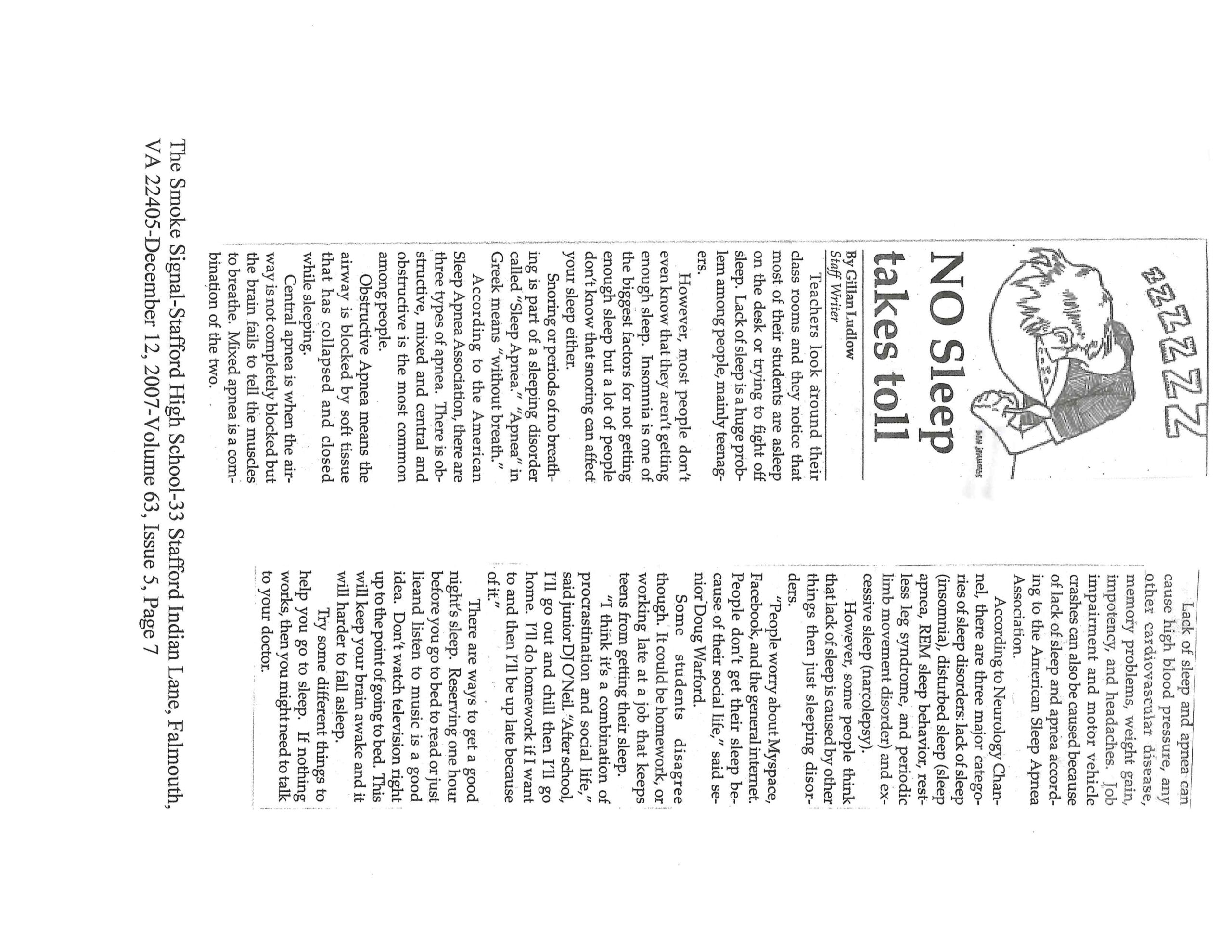
High school students are chronically sleep-deprived, and the consequences are showing up in classrooms, on athletic fields, and in doctors’ offices across the country. Stafford High School is no exception.
Experts recommend that teenagers get between eight and ten hours of sleep per night. Studies show that the average high schooler gets fewer than seven. The gap between recommended and actual sleep is widening, driven by early school start times, heavy homework loads, part-time jobs, and the pervasive glow of smartphone screens at midnight.
Sleep deprivation does more than make students tired. It impairs memory consolidation, which means that staying up late to study often backfires — the brain can’t retain information without adequate sleep to process it. It weakens the immune system, increases irritability, and in severe cases, is linked to depression and anxiety.
Sleep apnea — a condition in which breathing repeatedly stops during sleep — is another issue affecting some students. There are two main types: obstructive sleep apnea, caused by a physical blockage of the airway, and central sleep apnea, caused by the brain failing to send proper signals to breathing muscles. Both types result in poor sleep quality regardless of how many hours a person spends in bed.
“I usually get about five hours on a school night,” said senior Tyler Banks. “By Thursday I can barely keep my eyes open in first period.”
“I fall asleep in class more than I’d like to admit,” said junior Kayla Simms. “I don’t even realize I’m doing it until the teacher calls my name.”
Sleep researchers say the most effective interventions are consistent sleep and wake times, limiting screen use in the hour before bed, and advocating for later school start times — a policy change that has shown measurable academic benefits in districts that have tried it.